Why Basement Walls Begin to Bow
Your basement walls are designed to support your home while holding back the soil surrounding the foundation. Over time, pressure from that soil can become stronger than the wall itself. When this happens, the wall may begin to curve, crack, or move inward.
This pressure often increases when the ground around your home becomes saturated with water. Heavy rain, poor yard drainage, clogged gutters, improper grading, and repeated freezing and thawing can all place additional stress on foundation walls. Older block foundations may be especially vulnerable when moisture problems have gone unaddressed.
At A+ Waterproofing & Foundation Repair, we help homeowners throughout the Lehigh Valley and Poconos identify the cause of bowed basement walls and determine the right way to stabilize the foundation.
What Are the Warning Signs of a Bowed Wall?
A bowed basement wall is not always immediately obvious. The movement may begin gradually, and many homeowners first notice a crack rather than a visible curve in the wall.
Common warning signs include:
- Horizontal cracks across a basement wall
- Stair-step cracks in block or brick
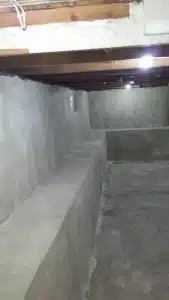
- A wall that appears curved or pushed inward
- Separation between the wall and the floor or ceiling
- Water leaking through foundation cracks
- Doors or windows that stick
- Uneven floors or cracks in drywall
- Gaps around doors and window frames
Small surface cracks do not always mean that the foundation is failing. However, horizontal cracks, widening cracks, wall movement, and water intrusion should be inspected promptly.
Why You Should Not Ignore Wall Movement
A bowed wall is usually a sign that outside pressure is affecting the foundation. The movement may continue if the underlying drainage, soil, or structural problem is not corrected.
As the wall shifts, cracks can widen and allow more moisture into the basement. Continued movement may also affect other parts of the home, leading to uneven floors, cracked drywall, misaligned doors, and additional structural concerns.
Waiting can limit your repair options. A wall that has only moved slightly may be easier to stabilize than one that has experienced significant displacement. Scheduling an inspection early gives us the opportunity to identify the problem before it becomes more extensive.
How Can a Bowed Basement Wall Be Repaired?
The right foundation repair method depends on the wall’s construction, the amount of movement, the condition of the surrounding soil, and the source of the pressure.
Carbon fiber wall supports may be recommended for certain walls that need reinforcement. We use quality products such as Rhino Carbon Fiber wall supports to help stabilize foundation walls without requiring a large amount of interior space.
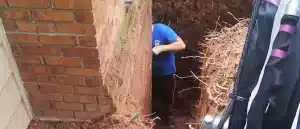
More serious foundation movement may require another repair method. Push piering can help extend a foundation to more supportive soil, while helical piles can anchor and stabilize a structure. Drainage improvements or waterproofing may also be needed when excess water is contributing to pressure against the wall.
There is no single solution that is right for every foundation. That is why we begin by looking at the entire situation rather than simply covering the crack.
Can Waterproofing Help Protect the Foundation?
Water management is an important part of many foundation repair plans. If rainwater or groundwater continues collecting around the home, structural repairs may not address the full cause of the problem.
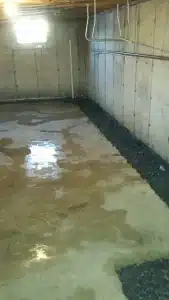
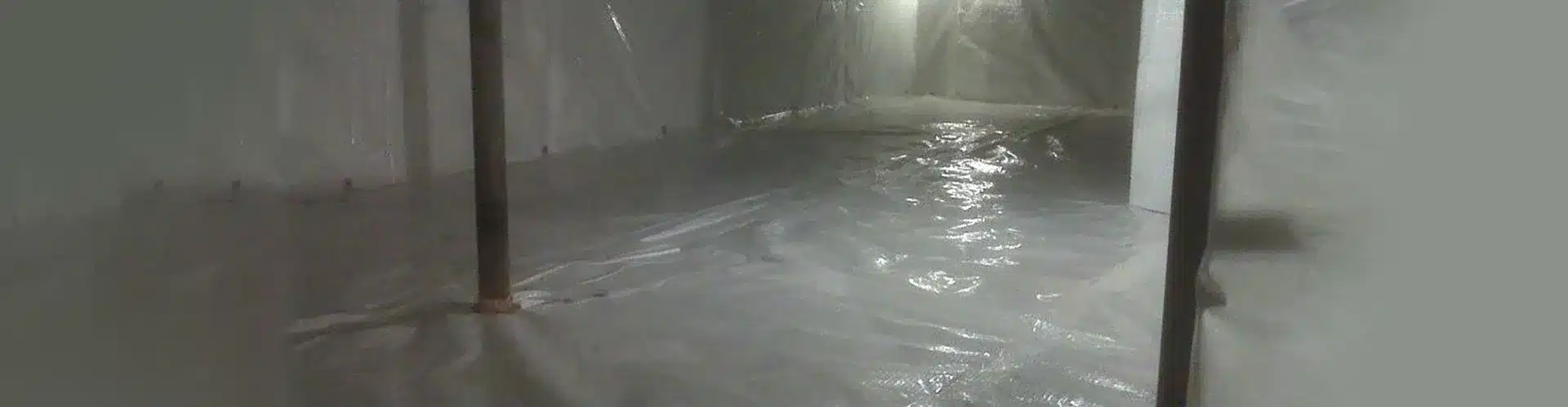
Depending on the property, we may recommend interior or exterior waterproofing, drain tile, a French drain, a sump pump, crack injections, yard drainage, or foundation sealing. These systems are designed to control moisture and reduce the risk of recurring water problems.
Schedule a Foundation Inspection
A bowed basement wall should not be treated as a cosmetic problem. It is a warning that your foundation may be under pressure and needs professional attention.
A+ Waterproofing & Foundation Repair provides customized foundation repair and waterproofing solutions throughout the Lehigh Valley and Poconos. We offer free on-site evaluations and will explain the recommended repair options based on the condition of your property.
Contact us today to schedule your free estimate and take the next step toward a safer, drier, and more stable home.